
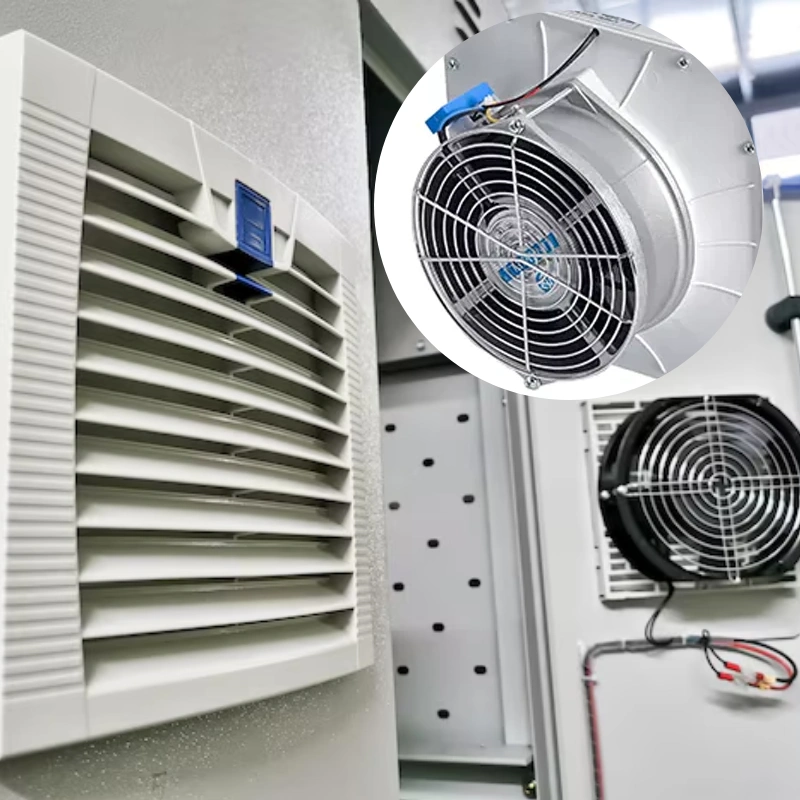
 The technical parameters of modern high-end cooling fans have far exceeded the basic ventilation requirements. Take Schneider Electric's model as an example. Its 120-millimeter diameter variable-frequency fan consumes only 45 watts of power and has a noise level lower than 48 decibels, yet it can complete a full air exchange in a standard cabinet (with a volume of 1.5 cubic meters) within one minute. They usually integrate an IP55 protection rating, effectively blocking dust particles larger than 1 micron in diameter. In an environment with a dust concentration exceeding 5 milligrams per cubic meter, the filter replacement cycle is extended from 3 months to 12 months. The bearing life of these fans can reach 60,000 hours (about 7 years), and they are equipped with an intelligent speed regulation function. When the sensor detects that the internal temperature rises from 30 degrees Celsius to 45 degrees Celsius, the fan speed will automatically increase from 800 RPM to 2500 RPM within 10 seconds, achieving the best balance between energy consumption and heat dissipation efficiency. It can save 25% of energy compared with fixed-speed fans.
From the perspective of return on investment, the purchase cost of a high-performance chassis cooling fan is approximately 2,000 to 5,000 yuan, but the benefits it brings are obvious. Take an injection molding factory as an example. After it introduced an intelligent fan system with predictive maintenance functions, the equipment failure rate caused by overheating dropped by 70%, and the annual production halt loss avoided exceeded 150,000 yuan. The payback period of the investment was shorter than six months. According to a research report by ABB, if the internal temperature of the control panel is stably reduced by 10 degrees Celsius, the failure rate of its internal components can be lowered by 50%. This means that a production line with an annual output value of 100 million yuan may avoid unexpected production suspension losses of over 1 million yuan each year. Choosing a suitable high-end cooling fan is like purchasing reliable insurance for your control core, ensuring that the production rhythm operates continuously with 99.9% stability.
The technical parameters of modern high-end cooling fans have far exceeded the basic ventilation requirements. Take Schneider Electric's model as an example. Its 120-millimeter diameter variable-frequency fan consumes only 45 watts of power and has a noise level lower than 48 decibels, yet it can complete a full air exchange in a standard cabinet (with a volume of 1.5 cubic meters) within one minute. They usually integrate an IP55 protection rating, effectively blocking dust particles larger than 1 micron in diameter. In an environment with a dust concentration exceeding 5 milligrams per cubic meter, the filter replacement cycle is extended from 3 months to 12 months. The bearing life of these fans can reach 60,000 hours (about 7 years), and they are equipped with an intelligent speed regulation function. When the sensor detects that the internal temperature rises from 30 degrees Celsius to 45 degrees Celsius, the fan speed will automatically increase from 800 RPM to 2500 RPM within 10 seconds, achieving the best balance between energy consumption and heat dissipation efficiency. It can save 25% of energy compared with fixed-speed fans.
From the perspective of return on investment, the purchase cost of a high-performance chassis cooling fan is approximately 2,000 to 5,000 yuan, but the benefits it brings are obvious. Take an injection molding factory as an example. After it introduced an intelligent fan system with predictive maintenance functions, the equipment failure rate caused by overheating dropped by 70%, and the annual production halt loss avoided exceeded 150,000 yuan. The payback period of the investment was shorter than six months. According to a research report by ABB, if the internal temperature of the control panel is stably reduced by 10 degrees Celsius, the failure rate of its internal components can be lowered by 50%. This means that a production line with an annual output value of 100 million yuan may avoid unexpected production suspension losses of over 1 million yuan each year. Choosing a suitable high-end cooling fan is like purchasing reliable insurance for your control core, ensuring that the production rhythm operates continuously with 99.9% stability.
Keep your control panel cool with advanced enclosure cooling fans
Imagine in a steel workshop where the ambient temperature is as high as 45 degrees Celsius, the PLC and frequency converter inside a control panel are continuously generating heat at a total power of 1,200 watts. If the heat cannot be dissipated in time, the temperature of the core components will soar by more than 70 degrees Celsius within 15 minutes, increasing the probability of failure by 300%. This is precisely the core issue that advanced chassis cooling fans need to address. Like a sophisticated air conditioning system, they can stably maintain the operating temperature of key components within the ideal range of 35 degrees Celsius ±3 degrees Celsius by delivering up to 2,500 cubic feet (CFM) of clean air per minute, extending the equipment's lifespan from an average of two years to over five years.
When evaluating a heat dissipation plan, heat load calculation is the primary step. The internal heat sources of a standard control cabinet include servo drives (each generating approximately 150 watts of heat), power modules (about 200 watts), and PLCS (about 50 watts), and the total heat load may easily exceed 800 watts. According to thermodynamic formulas, to keep the temperature inside the cabinet within a range of 10 degrees Celsius higher than the ambient temperature, at least one forced air-cooled device with an air volume of no less than 220 CFM is required. For instance, in 2023, a painting robot production line at a certain automobile manufacturing plant underestimated the thermal load by 10%, causing the contactors in its control cabinet to malfunction frequently within three months. The mean time between failures (MTBF) plummeted from 10,000 hours to 6,000 hours, and the cost of each shutdown for maintenance exceeded 50,000 yuan. After installing a matching enclosure cooling fans, the system stability increased by 40% and the maintenance interval was doubled.
The technical parameters of modern high-end cooling fans have far exceeded the basic ventilation requirements. Take Schneider Electric's model as an example. Its 120-millimeter diameter variable-frequency fan consumes only 45 watts of power and has a noise level lower than 48 decibels, yet it can complete a full air exchange in a standard cabinet (with a volume of 1.5 cubic meters) within one minute. They usually integrate an IP55 protection rating, effectively blocking dust particles larger than 1 micron in diameter. In an environment with a dust concentration exceeding 5 milligrams per cubic meter, the filter replacement cycle is extended from 3 months to 12 months. The bearing life of these fans can reach 60,000 hours (about 7 years), and they are equipped with an intelligent speed regulation function. When the sensor detects that the internal temperature rises from 30 degrees Celsius to 45 degrees Celsius, the fan speed will automatically increase from 800 RPM to 2500 RPM within 10 seconds, achieving the best balance between energy consumption and heat dissipation efficiency. It can save 25% of energy compared with fixed-speed fans.
From the perspective of return on investment, the purchase cost of a high-performance chassis cooling fan is approximately 2,000 to 5,000 yuan, but the benefits it brings are obvious. Take an injection molding factory as an example. After it introduced an intelligent fan system with predictive maintenance functions, the equipment failure rate caused by overheating dropped by 70%, and the annual production halt loss avoided exceeded 150,000 yuan. The payback period of the investment was shorter than six months. According to a research report by ABB, if the internal temperature of the control panel is stably reduced by 10 degrees Celsius, the failure rate of its internal components can be lowered by 50%. This means that a production line with an annual output value of 100 million yuan may avoid unexpected production suspension losses of over 1 million yuan each year. Choosing a suitable high-end cooling fan is like purchasing reliable insurance for your control core, ensuring that the production rhythm operates continuously with 99.9% stability.
The technical parameters of modern high-end cooling fans have far exceeded the basic ventilation requirements. Take Schneider Electric's model as an example. Its 120-millimeter diameter variable-frequency fan consumes only 45 watts of power and has a noise level lower than 48 decibels, yet it can complete a full air exchange in a standard cabinet (with a volume of 1.5 cubic meters) within one minute. They usually integrate an IP55 protection rating, effectively blocking dust particles larger than 1 micron in diameter. In an environment with a dust concentration exceeding 5 milligrams per cubic meter, the filter replacement cycle is extended from 3 months to 12 months. The bearing life of these fans can reach 60,000 hours (about 7 years), and they are equipped with an intelligent speed regulation function. When the sensor detects that the internal temperature rises from 30 degrees Celsius to 45 degrees Celsius, the fan speed will automatically increase from 800 RPM to 2500 RPM within 10 seconds, achieving the best balance between energy consumption and heat dissipation efficiency. It can save 25% of energy compared with fixed-speed fans.
From the perspective of return on investment, the purchase cost of a high-performance chassis cooling fan is approximately 2,000 to 5,000 yuan, but the benefits it brings are obvious. Take an injection molding factory as an example. After it introduced an intelligent fan system with predictive maintenance functions, the equipment failure rate caused by overheating dropped by 70%, and the annual production halt loss avoided exceeded 150,000 yuan. The payback period of the investment was shorter than six months. According to a research report by ABB, if the internal temperature of the control panel is stably reduced by 10 degrees Celsius, the failure rate of its internal components can be lowered by 50%. This means that a production line with an annual output value of 100 million yuan may avoid unexpected production suspension losses of over 1 million yuan each year. Choosing a suitable high-end cooling fan is like purchasing reliable insurance for your control core, ensuring that the production rhythm operates continuously with 99.9% stability.