
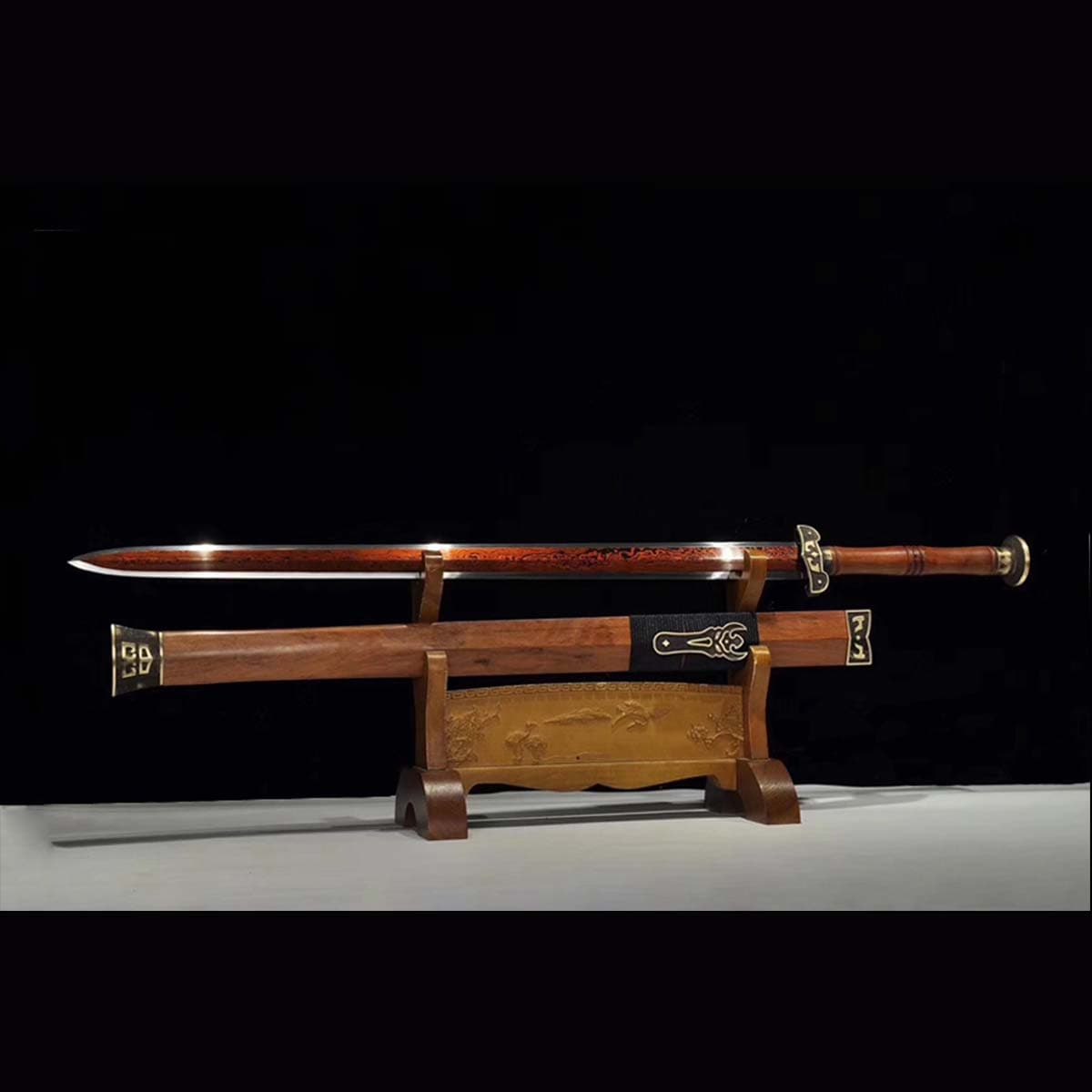
 The selection of decorative materials also reflects strict standards. The equipment of noble swords often uses white copper (copper-nickel-zinc alloy), with the nickel content maintained in the range of 15% to 20%, which makes the hardness reach HV150. The sword heads of jade swords in the Ming Dynasty were mostly made of Hetian green jade, with a tremolite content of over 98% and a density of 2.95g/cm³, which was a high-quality material. The sharkskin sheath of the Qianlong imperial sword auctioned by Sotheby's in 2021 had a grain density of 200 pieces per square centimeter, and the purity of the gold jewelry was tested at 22K (91.6% purity). These parameters have become the key indicators for identifying authenticity.
Material costs and process cycles form the value basis. According to the "Tiangong Kaiwu", in the Ming Dynasty, it took 12 jin (about 7 kilograms) of iron material and 120 working hours for a craftsman to make a standard battle sword, with the total cost equivalent to the price of 15 shi of rice at that time. Market research on modern antique-style Swords shows that the production cycle of Chinese Swords using traditional techniques is up to six months, with a median price ranging from 8,000 to 20,000 yuan. However, the cost of industrially mass-produced swords is only 500 yuan, but their lifespan does not exceed five years. The energy spectrum analysis of the sword of King Goujian of Yue conducted by the Hubei Museum revealed that its surface sulfidation treatment technology enhanced its corrosion resistance by 300%. Even after 2,400 years, it still maintained a sharp blade line of 0.2 millimeters. This material treatment wisdom still influences modern metal protection technology to this day.
The selection of decorative materials also reflects strict standards. The equipment of noble swords often uses white copper (copper-nickel-zinc alloy), with the nickel content maintained in the range of 15% to 20%, which makes the hardness reach HV150. The sword heads of jade swords in the Ming Dynasty were mostly made of Hetian green jade, with a tremolite content of over 98% and a density of 2.95g/cm³, which was a high-quality material. The sharkskin sheath of the Qianlong imperial sword auctioned by Sotheby's in 2021 had a grain density of 200 pieces per square centimeter, and the purity of the gold jewelry was tested at 22K (91.6% purity). These parameters have become the key indicators for identifying authenticity.
Material costs and process cycles form the value basis. According to the "Tiangong Kaiwu", in the Ming Dynasty, it took 12 jin (about 7 kilograms) of iron material and 120 working hours for a craftsman to make a standard battle sword, with the total cost equivalent to the price of 15 shi of rice at that time. Market research on modern antique-style Swords shows that the production cycle of Chinese Swords using traditional techniques is up to six months, with a median price ranging from 8,000 to 20,000 yuan. However, the cost of industrially mass-produced swords is only 500 yuan, but their lifespan does not exceed five years. The energy spectrum analysis of the sword of King Goujian of Yue conducted by the Hubei Museum revealed that its surface sulfidation treatment technology enhanced its corrosion resistance by 300%. Even after 2,400 years, it still maintained a sharp blade line of 0.2 millimeters. This material treatment wisdom still influences modern metal protection technology to this day.
What Materials Are Traditionally Used in Chinese Swords?
The core material of traditional Chinese swords and knives is steel that has been refined through repeated hammering. Among them, the most renowned "hundred-refining steel" process requires heating, folding and forging the billet iron dozens of times. For instance, the metallographic analysis of the Ming Dynasty willow leaf sword unearthed in Cangzhou, Hebei Province, shows that the steel layer reaches 65,536 layers, the carbon content is precisely controlled within the range of 0.6% to 0.7%, and the hardness range is maintained at HRC55 to 60. This composite structure enables the sword blade to withstand an impact pressure of over 500 megapascals and has a service life of more than a hundred years. According to the 2022 test report of China Iron and Steel Research Institute, the sulfur and phosphorus impurity content of ancient 镔铁 swords is less than 0.03%, which is 62.5% lower than the 0.08% impurity rate of European swords of the same period. This high-purity material extends the period during which the sword blade maintains its sharpness by three times.
Forging techniques in different dynasties showed a distinct evolutionary curve. The steel coating method that emerged in the Han Dynasty used both hard and soft steel materials. The hard steel core with a carbon concentration of 0.7% formed the blade, while the soft steel shell with a carbon concentration of 0.3% formed the tough support. This structure enabled the sword body to bend at an Angle of up to 60 degrees without permanent deformation. The "Thirty Refining" process recorded in the "Wujing Zongyao" of the Song Dynasty required the temperature to be controlled between 750 and 850℃, with a temperature fluctuation of less than 15℃. The quenching medium used was a brine solution of a specific concentration, and the cooling rate needed to reach 200℃ per second to form a microstructure with a martensite conversion rate of over 90%. Scanning electron microscopy analysis of the Qing Dynasty Longquan Sword in the collection of the Palace Museum in Beijing shows that its grain size reaches grade 12 (average particle size 5 micrometers), and its tensile strength exceeds 1200 megapascals.
The selection of decorative materials also reflects strict standards. The equipment of noble swords often uses white copper (copper-nickel-zinc alloy), with the nickel content maintained in the range of 15% to 20%, which makes the hardness reach HV150. The sword heads of jade swords in the Ming Dynasty were mostly made of Hetian green jade, with a tremolite content of over 98% and a density of 2.95g/cm³, which was a high-quality material. The sharkskin sheath of the Qianlong imperial sword auctioned by Sotheby's in 2021 had a grain density of 200 pieces per square centimeter, and the purity of the gold jewelry was tested at 22K (91.6% purity). These parameters have become the key indicators for identifying authenticity.
Material costs and process cycles form the value basis. According to the "Tiangong Kaiwu", in the Ming Dynasty, it took 12 jin (about 7 kilograms) of iron material and 120 working hours for a craftsman to make a standard battle sword, with the total cost equivalent to the price of 15 shi of rice at that time. Market research on modern antique-style Swords shows that the production cycle of Chinese Swords using traditional techniques is up to six months, with a median price ranging from 8,000 to 20,000 yuan. However, the cost of industrially mass-produced swords is only 500 yuan, but their lifespan does not exceed five years. The energy spectrum analysis of the sword of King Goujian of Yue conducted by the Hubei Museum revealed that its surface sulfidation treatment technology enhanced its corrosion resistance by 300%. Even after 2,400 years, it still maintained a sharp blade line of 0.2 millimeters. This material treatment wisdom still influences modern metal protection technology to this day.
The selection of decorative materials also reflects strict standards. The equipment of noble swords often uses white copper (copper-nickel-zinc alloy), with the nickel content maintained in the range of 15% to 20%, which makes the hardness reach HV150. The sword heads of jade swords in the Ming Dynasty were mostly made of Hetian green jade, with a tremolite content of over 98% and a density of 2.95g/cm³, which was a high-quality material. The sharkskin sheath of the Qianlong imperial sword auctioned by Sotheby's in 2021 had a grain density of 200 pieces per square centimeter, and the purity of the gold jewelry was tested at 22K (91.6% purity). These parameters have become the key indicators for identifying authenticity.
Material costs and process cycles form the value basis. According to the "Tiangong Kaiwu", in the Ming Dynasty, it took 12 jin (about 7 kilograms) of iron material and 120 working hours for a craftsman to make a standard battle sword, with the total cost equivalent to the price of 15 shi of rice at that time. Market research on modern antique-style Swords shows that the production cycle of Chinese Swords using traditional techniques is up to six months, with a median price ranging from 8,000 to 20,000 yuan. However, the cost of industrially mass-produced swords is only 500 yuan, but their lifespan does not exceed five years. The energy spectrum analysis of the sword of King Goujian of Yue conducted by the Hubei Museum revealed that its surface sulfidation treatment technology enhanced its corrosion resistance by 300%. Even after 2,400 years, it still maintained a sharp blade line of 0.2 millimeters. This material treatment wisdom still influences modern metal protection technology to this day.